


8 days in Slovenia, Our Slovenia Travel Itinerary - Wine Valley and Ljubljana

Updated: Feb 23
We travelled to Slovenia during the month of August, which is considered to be one of the best times of the year to visit. Located in central Europe, Slovenia was formerly part of Yugoslavia and currently is surrounded by Austria, Hungary, Croatia and Italy; Slovenia is known for its natural beauty, mountains, lakes, wine producing regions and beautiful towns by the Adriatic Sea.

We landed at the country’s capital Ljubljana by air from London and picked up a car from the airport and drove around the central, north-west, west and south-west part of the country. This is how we spent 8 days in Slovenia, our Slovenia travel itinerary through the wine valley and capital city of Ljubljana.
This is part two of our travel story, for initial part of our Slovenia itinerary check part one of this Slovenia blog here.
After exploring the lakes and gorges in Triglav National Park and hiking in Julian Alps, it was time for us to explore the western and south-western part of the country, Slovenia's its wine region and last but not the least, its capital Ljubljana.
Day 5: Exploring wester part of Slovenia, remaining of Soca valley
On day 5 after breakfast, we checked out of the property and started driving towards the south-western part of the country which is famous for picturesque small villages and vineyards spread across the region. Enroute we stopped at a number of attractions as planned.
Lago del Predil or Predil Lake

Predil Lake or Lago del Predil as called in Italian, is a stunningly beautiful natural lake located at a height of around 970 meters from sea level in the northeast part of Italy in an ancient glacial valley. The lake is located around 10 kilometres from the Italian town of Tarvisio and the area is very close to Slovenia border.

The picturesque alpine lake is the second largest natural lake of the region. The water of the lake is clear and deep blue-green in colour. The lake is surrounded by mountains and the refection of the mountains on lake creates a tranquil surrounding.

The lake is located next to the road that goes from Kranjska Gora towards the south-western part of Slovenia and passes briefly through Italy. There is a large enough paid car park next to the lake where parking is available. This parking area is also used as a campervan site. From this car park a walking path heads towards the lake and goes around the most part of the lake. The lake is very popular for swimming in summer and for kayaking and paddleboarding as well.
Fort Kluže
We continued our journey towards south through Soča valley and arrived at the next attraction of the day – Fort Kluže

Located around 70 meters above the Koritnica gorge in between the steep slopes of two mountains, the fort was initially built in the 15th century as defence against the Turkish invasion. Considered as one of the most visited tourist attractions in Soča valley, it was initially built as a wooden fortification. A century later stone fortification was built around it. The fort was an important defensive position for Austrian soldiers against general Napoleon Bonaparte’s army in the 18th century. Later the wooden structures were destroyed in fire and replaced with stone and concrete structure which stands tall till date and played an important role during First World War.
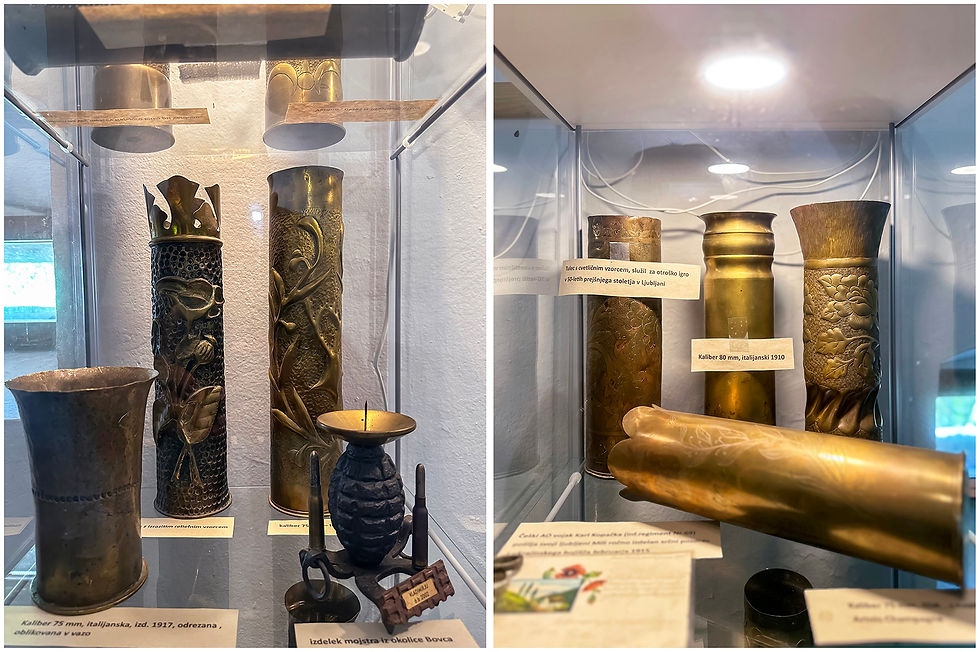
Today, the fort has been transformed into a museum exhibiting many items from the past including a large collection of ammunitions, uniforms etc from the period of First World War.
There is a small car park at the main entrance which gets filled up pretty quickly. Apart from the car park there are plenty of free roadside parking near the fort.
Boka Falls
Continuing our journey towards south we drove down the Bovec-Žaga road to our next destination – the Boka waterfall. Considered as the most beautiful and picturesque waterfall of Slovenia, Boka waterfall is a 144 meter high waterfall which gets fed by the waters accumulating in the high mountains of the Kanin Mountain chain. The waterfall turns into a majestic cascade during spring when snow starts to melt in the mountains and with plentiful of rainfall in autumn months.

The folklore behind the creation of the waterfall tells a rather cruel story: a boy and a girl went up the mountain for foraging mushrooms. Exhausted and hungry they knocked the door of a small mountain house which belonged to an old lady. The lady gave them food. While eating the boy had a hunch that the old lady was plotting to kill him and the girl and found her sharpening her axe outside the house. The body hid behind the entrance of the house with a stick in hand and hit the old lady when she tried to enter the house. The boy then killed the old lady with the axe and the blood of the old lady turned into a waterfall.

The waterfall is located next to the Bovec-Žaga road near a bridge on the right-hand side. There is a relatively big free car park next to the bridge from where the viewpoint of the waterfall is around 15 minutes of walk. After parking the car and crossing the bridge a well-marked dirt road leads to the viewpoint. The viewpoint offers a beautiful view of the waterfall and a great spot for photos. You can continue further in the path for even better view of the waterfall, though the path beyond the viewpoint is more difficult and very steep in few areas. We only walked up to the viewpoint like most of the other visitors, took some photos and returned to the car park.
Kanal ob Soči
Continuing our drive towards the south along the Slovenia-Italy border, we arrived at the picturesque medieval town Kanal ob Soci around lunchtime. Just before entering the town, we stopped for lunch at a restaurant named Okrepčevalnica Pirih. Located by the bank of Soča River and popular among locals, the restaurant’s outdoor seating area offers a scenic view of the surrounding area. We enjoyed a relaxing lunch before continuing further.

Located in the middle of the Soča valley, we reached the town of Kanal which was considered an important crossing point during the Roman times due to its strategic location. Today the town is a popular holiday destination involving activities such as hiking, fishing and swimming in the river.

The most recognisable landmark of the town is the stone bridge over the Soča River. The bridge also hosts famous jumping competitions during summer. We stopped near the bridge and took a few snaps before continuing to the wine region of Slovenia.
Goriška Brda:
Our final destination of the day was one of the wine regions of western Slovenia - Goriška Brda. Part of the Primorska region of Slovenia, Goriška Brda is also called the Tuscany of Slovenia due to its picturesque rolling hills covered in vineyards and dotted with small villages. Located along the border of Italy, this region lies between Julian Alps in the north and Mediterranean Sea in the south. Due to the hilly topography of the region most of the vineyards are terraced. Due to which the use of machine is almost non-existent in this region’s vineyards and work is done manually including harvesting. Most of the vineyards are family run and part of closely knit community.

The wine growing region gets extended into the villages of Italy on the other side of the border. We booked a family-owned villa for our stay in the middle of the vineyard, a few kilometres inside Italy in a village called Valerisce. We stayed in the villa for couple of nights and ventured into some of the picturesque villages in the region of Goriška Brda.
Konvin Wine Bar & Restaurant:


While arriving at the villa late in the afternoon we noticed an open-air wine bar in the middle of a vineyard at the Slovenia-Italy border and decided to pay a visit. So after checking in into the villa we headed to the wine bar to enjoy wine in the late afternoon sun surrounded by vineyards. Konvin Wine Bar & Restaurant is located on the border between Slovenia and Italy, and half of the tables were on the Italy side while the main bar area was on the Slovenia side. We picked up a glass of local wine and sat down on a table at the edge of the vineyard and enjoyed a relaxing evening.
Day 6: Exploring Goriška Brda region of Slovenia
The region of Goriška Brda is dotted with small yet picturesque villages, we visited some of these villages during our stay in the area.

We started our day with a spread of breakfast while enjoying the picturesque view of the vineyards from villa’s balcony.


After breakfast, we decided to explore the vineyard located next to our villa. We walked around the vineyard, sampled some sweet grapes and took a lot of pictures. After enjoying a lazy stroll in the vineyard, we drove out to explore few villages in the region.
Vipolže:

We started at the village of Vipolže where we drove around the narrow roads of the village and stopped at a few spots to enjoy picturesque view of the valley in front. It is considered as one of the most beautiful villages of the region and houses a number of award-winning wineries.
Dobrovo

Our next stop was the village of Dobrovo, the administrative centre of Municipality of Brda. The village is famous for Dobrovo Castle which was built during 17th century on the foundation of an existing structure. The castle is prefect square and has four square turrets at each of the four corners. The castle was opened for public in 1991 after Slovenia received its independence. Currently the castle houses an art gallery exhibiting works of painter Zoran Mušič and a museum. Unfortunately, the art gallery was closed when we went.

While walking in the castle courtyard we discovered a brass bust of the first Indian prime minister – Sri Jawaharlal Nehru. The bust was installed by Indian Council for Cultural Relations in Slovenia and was inaugurated by former Lok Sabha Speaker of India Meira Kumar in June 2013.
Krčnik Natural Stone Bridge

We drove down to the next attraction of the day near the village of Kožbana – The natural stone bridge, by the Kožbanjšek stream. In the limestone belt, the Kožbanjšek stream has created a few exceptionally beautiful natural flumes called Krčnik. This natural attraction features a almost 40 meters long gorge and a naturally carved stone bridge over the gorge. The location of the stone bridge is in the middle of a forested area lead by a narrow road. There is a very small parking for a handful of cars and a tourist signboard next to the road. From parking the Krčnik is a 5 min walk. The edge of the flumes is well paved and supported by metal barrier for safety. The gorge was filled with very slow flowing emerald-green coloured water and the area surrounding the gorge was overgrown with moss and vegetation. When we visited the place, we were the only people around there. We enjoyed the quietness of the place before heading for lunch.

Within 10 minutes of driving distance of Krčnik Natural Stone Bridge and the near the village of Slavče we found a popular local restaurant named Gostilna Peternel. Because it was crowded with locals, we gathered it must be good! We ordered fresh salad, fried breaded chicken and deep-fried calamari along with local beer, and we were not disappointed!
Village of Kojsko:


After lunch we drove to the hilltop village of Kojsko which offers some of the best views of the vineyards in the region. We walked around the village, noticed a few old buildings of the Yugoslavia era with scars from the past still visible on the surfaces of the buildings. We walked to a viewpoint, sat on a bench to admire the view of the hills in front of us.
From there we headed towards our next spot of the day – the village of Šmartno.
Village of Šmartno


Located in the centre of the Gorizia hill, the village of Šmartno is a cultural heritage monument and the most popular village for visitors in the region. The village was built on a roman foundation and during 16th century a walled fortified outpost with seven watch towers around the periphery of the village was built to defend against the Turkish incursion. The village houses Church of St. Martin, the biggest parish church in Brda and the village was built around the church itself. The village still holds a medieval charm with its buildings and narrow lanes. The village is the venue of the Brda gastronomy festival and houses a number of restaurants, a wine tasting center, and wine making museum.


We strolled through the picturesque village and took a lot of pictures. Just before sunset we headed towards the last destination of the day- the village of Gonjače.
Bronze monument in Gonjače and Lookout Tower:

Located atop a hill in the village of Gonjače, a monument was built in the memory of 315 victims of the Second World War on the right bank of the Soča River. The monument was designed by painter and sculptor Janez Boljka and the verses engraved on the bronze plaque at the monument were written by the writer France Bevk.

Next to the monument a 23 meters high watch tower was built in 1961. The 144 stairs of the spiral staircase lead to the viewing platform at the top of the watch tower which offers a 360-degree view of the region of Brda. The tower represents the central point of Brad. On a good day the sunset view from the top of the watch tower is truly one of the best experiences of the region. The watchtower also offers a stunning view of the nearby village of Šmartno. We climbed the slightly wobbly stairs to the top just in time for sunset and enjoyed the breathtaking view of the surroundings.

With the setting sun at the horizon, we called it a day and drove back to our villa to enjoy the serenity of the small Italian village we were staying in while enjoying a glass of local wine and preparing our dinner.
Day 7: Visit to local winery, Predjama Castle and driving back to Ljubljana
After enjoying a refreshing breakfast, we checked out from of villa and drove to a nearby winery for wine tasting before heading to Predjama Castle.
Humar Vini Winery

5 minutes of drive from the villa brought we arrived at the Humar Vini winery. We had a winery tour and wine tasting booked in advance, so when we arrived, we were greeted by the lovely lady who was also the owner of the small winery. She took us for a walking tour in the vineyards adjacent to the winery and talked about the types of grapes that grew in this part of the world, the harvest time etc. Then we had a quick visit into the winery where the harvested grapes are washed, crushed and then fermented in large industrial scale fermenters. After learning about the various steps of wine making, we headed towards the wine tasting area where we were offered few glasses of wines, which we enjoyed so also bought couple of bottles and bid goodbye to the lovely owner and started our long drive to Predjama Castle.
Predjama Castle

Renowned as world’s largest cave castle, Predjama Castle is one of the top tourist attractions in Slovenia and attracts thousands of visitors each year. Due to its location, the castle is popular among visitors as day trip from the capital Ljubljana. Set inside the second largest cave of Slovenia, the Predjama castle was built during the 12th century by a German family - the Luegg’s, Slovenia was then part of the German empire. The most famous resident of the castle was Erasmus Luegg from 15th century. During his time the castle was under siege by the Habsburgs for over a year. During this time the residents of the castle managed to get their food supplied through hidden cave system under the castle. Eventually the resistance was broken when a servant betrayed Erasmus and a perfectly aimed cannon killed Erasmus while he was in the loo! At this point the castle was significantly damaged from the Habsburgs attack. After the siege, the Oberburg family took over the castle and rebuilt it around 1510. Unfortunately, soon after, in 1511 the castle was nearly destroyed during a massive earthquake. Finally in 1570, the current castle was built. Thereafter the castle was used as hunting lodge for Austrian aristocrats, finally after WWII Yugoslavian government put an end to this and opened it for public.
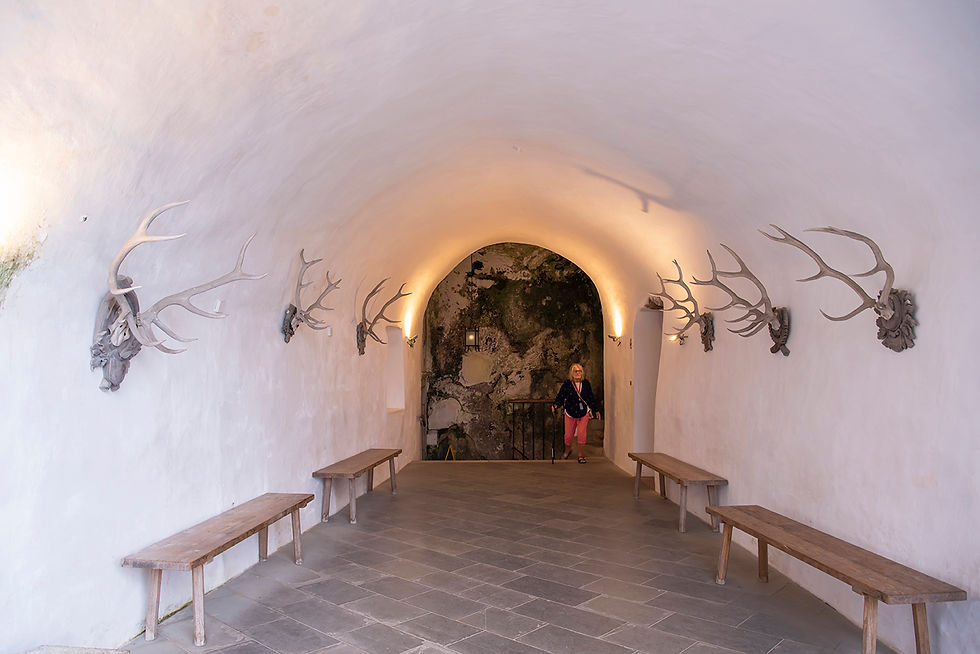

Before the castle was built, the cave was home to people from the Paleolithic era. The current castle is 5 stories high and stood at the face of 123-metre high limestone cliff. Inside the castle there are a number of rooms that are now converted to museum to display armouries, exhibit kitchen area, prisons, bedroom etc. The construction inside the castle is a perfect blend of man-made building and naturally formed cave system.

The upper cave system is one of the main attractions of the castle. The entrance to the upper cave system lies at the top of the castle. The entrance to the cave system is small which made it easily defendable in the time of siege. The upper cave system used to serve as hiding place for the residents of the castle should the castle security be breached. Inside the upper cave system, stairs have been constructed for the visitors to explore the cave system. The stalagmite and stalactite structures inside the upper cave system is worth a visit by climbing a few steps.

The best view of the castle is from outside. There are a number of spots leading from ticket office towards the castle from where nice pictures of the castle can be taken. There are a couple of big car parks 5 min walking from the castle and near the ticket office there are a number of good restaurants as well.
After visiting the castle, we had a good lunch in one of the restaurants at the foot of the Predjama castle and drove back to Ljubljana through heavy rain and heavy traffic in the motorways.
Worth mentioning here that we skipped visit to Predjama cave, which is the other top attraction in the area and located around 5 miles from the Predjama castle. Predjama cave is the largest cave system of Slovenia and attracts hundreds and thousands of visitors each year. It’s a great place for kids to enjoy train ride inside the cave system. We skipped visiting this cave and headed back to the capital. We arrived back to Ljubljana in the evening, returned our rented car and took a cab to the hotel in the city.
Day 8: Exploring the city of Ljubljana
This was our last full day in the beautiful country of Slovenia, we filled the day by visiting some of the major touristic landmarks of the capital city Ljubljana. After breakfast we set out to explore the old town where all the major attractions are located. We started the sightseeing of the capital with a visit to the most iconic attraction of the city – the Ljubljana Castle.
Ljubljana Castle

One of the top attractions of the capital of Slovenia, Ljubljana castle is located at the top of a 375 meters high hill just outside the wall of the old town of Ljubljana and has been standing tall for over 900 years. Believed to be built during the early 12th century by powerful Spanheim family, the original castle was a wooden structure to control the vital trade routes that passed through the area. During 14th century the old castle structure was destroyed by Habsburg dynasty when it took control of the area. The Habsburgs constructed the stone castle on the site realizing the importance and strategic location of the place. The stone castle built by the Habsburgs is the fortress visitors see today. Soon after construction, the castle turned to a defensive stronghold against the Ottoman invasion. The thick stone walls of the castle, the strategically located watch tours and ramparts helped defend the castle and town below from numerous sieges. Due to this the castle soon became the symbol of Habsburg power. During the early 19th century, the castle was modified into a military hospital and then was converted to state penitentiary until the castle was hit by a devastating earthquake that struck the city in 1895. During WWI the castle was used to hold prisoners from the Italian front and during WWII the castle was occupied by Nazis. Post war the castle was used as a shelter for war affected citizens of Ljubljana.

Visting the castle ground is free, but visitors are required to purchase tickets to visit the watch towers, the Chapel of St George, the prisons and museum located inside the castle. The watch tower and the ramparts offer some of the most beautiful views of the old town and the city at the foot of the hill and the green landscape that surrounds the city of Ljubljana.

Visitors can reach the castle by three different ways, the easiest is a 70-metre long funicular that originates in the old town near the Vodnikov market square. Apart from the funicular the other option is a short tourist train that departs every hour from the Ljubljana tourist information centre. And the last and perhaps the most difficult option is taking one of the three walking routes through the woods leading to the castle. The walking path we look was steep in few places and took us around 20 min to reach the top.
We spent a couple of hours in the castle, exploring the museum, prison, chapel and the lookout tower before we walk back to the old town.
Dragon Bridge
The Dragon Bridge is perhaps one of the most iconic sights in the city of Ljubljana and most recognisable image of the city. No visit to the city of Ljubljana is complete without a picture taken with one of the bronze dragon statues of the bridge.

Built in 1900, the bridge was initially named the Jubilee Bridge to commemorate 40 years of Emporer Franz Josef I’s rule. Later the bridge was renamed as Dragon Bridge in the year 1919. The Dragon bridge is the first bridge in Europe that was built using reinforced concrete replacing the old wooden bridge called the Butchers bridge which was built in 1819. The Dragon bridge is not only a piece of technical heritage, but also a fine example of Art Nouveau architecture from early 20th century and holds significant mythical history of Ljubljana.

The bridge houses four bronze dragon statutes, two located at each end of the bridge and are said to symbolize the strength and pride of Ljubljana. According to the folklore, a Greek mythical hero named Jason along with his Argonauts arrived in the area of Ljubljana on their way back from stealing the Golden Fleece. According to the story, the regions waters were guarded by a fierce dragon, Jason fought and slayed the dragon to free the region of it’s terror. With time the legend of Jason and dragon grew to symbolize strength, protection, and victory over challenges
Triple Bridge & Prešeren Square

The Triple Bridge, or Tromostovje, spanning the Ljubljanica River is a blend of history and architecture and a prominent landmark in the old town of Ljubljana. During 13th century, a wooden bridge over Ljubljanica River used to serve as a vital crossing for trade routes between northwestern Europe and the Balkans. In the year 1842 the old wooden bridge was replaced by a stone bridge and was called Špital (Hospital) Bridge. By the start of the 20th century, the traffic of vehicles and pedestrians crossing the bridge increased. To resolve this the renowned architect of Slovenia Jože Plečnik added two angled pedestrian bridges on either side on the central bridge between 1929 and 1932. Thus, the central stone bridge along with two angled bridge crates a fan-like design and directs the movement of the pedestrians towards Prešeren Square and the old town. The old metal railings from the old bridge were removed and all three bridges were fitted with stone balustrades and lamps. Also from each of the pedestrian bridges two staircases were built to connect the terraces above the river on both sides. And the name of the bridge then changed from Špital (Hospital) Bridge to Tromostovje or Triple Bridge.
During sunset the bridge offers a beautiful view of the old town and Prešeren Square from the east side of the river.

Located next to the Triple Bridge, Prešeren Square is the famous square of the old town of Ljubljana named after the country’s famous poet France Prešeren. The square started its journey as a road junction in front of one of the city gates of medieval Ljubljana. During 17th century, when the Franciscan church of the Annunciation was built next to the junction, the junction was then turned into a square and during middle of 19th century, once the city wall was removed the square was paved. The square represents a mixture of architectural styles from various eras of Ljubljana, from Baroque churches to modern Art Nouveau buildings. The Baroque-style church with its iconic pink façade built during the middle of the 17th century is a symbol of the Franciscan monastic order and is one of the most photographed landmarks in the square.

After the 1895 earthquake, architect Max Fabiani redesigned the square and added new palaces around the square. Along with sculptor Ivan Zajc architect Max Fabiani also designed the Prešeren Monument in the square which was unveiled in 1905. The statue and the square remain till date a profound landmark and meeting point for the locals and visitors to the city.
Ljubljana Cathedral (Cathedral of St. Nicholas)
Located in the heart of the old town, Ljubljana Cathedral plays a central role in the city’s religious life and is home of the Archbishop of Ljubljana. The cathedral is a must-see attraction of the city and is masterpiece of Baroque architecture with stunning frescoes, grand dome and bronze doors.
Ljubljana Cathedral is constructed on the site of a Romanesque church built in the year 1262 to serve the residents of medieval Ljubljana. Since its original construction, the church went through several rebuilds and reconstructions to become the current architectural masterpiece.

The original Romanesque church was destroyed in a fire in 1361 and was rebuilt in Gothic style with pointed arches. And in 1461 when Ljubljana became a diocesan seat, the church again underwent major renovations and alterations. However, in 1469 the church was burnt down by the Turks and was rebuilt again.
During the early 1700s (from 1701 to 1706), the church was rebuilt in Baroque architectural style by the Jesuit architect Andrea Pozzo as the old Gothic structure of the church was no longer serving the religious needs of the population of the city. Architect Andrea Pozzo designed the new layout in the shape of a Latin Cross which resulted in a specious hall and side chapels and gave birth to the era of the cathedral. In early 1700s when the Baroque style cathedral was built, no dome was constructed, and the cathedral had a painted illusion of a dome on the arch above the centre of the cross. Finally in 1841 a green coloured dome was built adding to the skyline of the city. Once the design of the cathedral was complete, it elaborates frescoes and ornate ceiling gave the cathedral its grand look.

During the 18th century, the interior of the cathedral was filled with intricate paintings made by various artists including Giulio Quaglio, Angelo Putti, Francesco Robba and many others. Additions of artwork continued during 19th century, one of the significant additions was dome fresco painted by Matevž Langus in 1844. Later during the 20th century to commemorate 1250 years of Christianity in Slovenia, bronze sculpted doors were installed. The sculpted door considered as significant addition to the cathedral, depicts key moments in the nation’s religious history.
After concluding our visit to the Cathedral of St. Nicholas, we strolled through the streets of the old town in the evening and enjoyed our last few hours in the beautiful capital city of Slovenia. After a relatively early dinner we called it a day and returned to hotel for a well-deserved rest after a long day of walking and sightseeing.
Day 9: Time to Fly Back Home
We Checked out early in the morning and headed to the airport to catch our return flight to London. Filled with lots of beautiful memories and experiences we bid farewell the beautiful central European country and flew back home.


Comments